










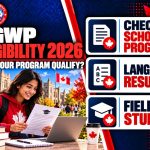



















A college or university may offer a legitimate Canadian program that still does not satisfy every post-graduation work permit (PGWP) requirement. For some graduates, one critical question is whether the program’s six-digit Classification of Instructional Programs (CIP) code meets IRCC’s field-of-study rule.
Consider Maya, a fictional student accepted into a two-year Canadian college diploma. The school was a designated learning institution (DLI), and its website discussed PGWP eligibility. Maya assumed that every graduate of the diploma would qualify. Before paying her deposit, she discovered that the field-of-study rule could apply because she would submit her study permit application after November 1, 2024. She needed the program’s actual CIP code and an accurate eligibility check, not a general claim about the school.
This guide explains who must meet the field-of-study requirement, how the 2026 list freeze works, how to verify a code and what evidence to submit with a PGWP application. It provides general public information, not a promise of approval.
Who Must Meet the PGWP Field-of-Study Requirement?
IRCC’s current rules generally require an eligible field of study for graduates of other university programs and college, polytechnic or non-university programs if they submitted their study permit application on or after November 1, 2024.
IRCC lists four situations in which a graduate does not need to meet this field-of-study requirement:
- The PGWP application was submitted before November 1, 2024.
- The applicant graduated from a PGWP-eligible flight school.
- The applicant graduated with a bachelor’s, master’s or doctoral degree.
- The applicant applied for a study permit before November 1, 2024.
The degree exemption concerns the credential earned, not merely the name of the institution. A university certificate or diploma may still face the field-of-study requirement. Conversely, a qualifying bachelor’s degree does not acquire a field restriction simply because its major is outside a listed category.
Use IRCC’s PGWP eligibility page and field-of-study instructions to identify your category.
What Is a Six-Digit CIP Code?
CIP is a classification system for post-secondary educational programs. For PGWP purposes, IRCC uses six-digit codes based on CIP Canada 2021. They are displayed in a format such as 11.0701.
A CIP code describes the field of the study program. It is not a National Occupational Classification (NOC) code for a job, a school’s DLI number, a program marketing name or the applicant’s intended occupation after graduation.
Two programs with similar titles can have different curricula and CIP codes. A broad title like “Business Technology” is not enough to decide which code applies. Likewise, seeing one computer-related code on the eligible list does not mean that all programs advertised as technology programs qualify.
IRCC suggests checking the DLI’s website, contacting the DLI and consulting the Statistics Canada CIP classification catalogue. The catalogue’s descriptions, examples and exclusions help determine whether a code fits the actual curriculum. Ask the school for its applicable six-digit code and the records supporting that classification before relying on a PGWP claim.
How Do You Check Whether the Code Is Eligible?
Follow a sequence that preserves the dates and documents:
- Identify the exact program and credential you will complete.
- Obtain the applicable six-digit CIP code from the DLI and compare it with the program description.
- Confirm whether the field-of-study requirement applies to you at all.
- Search the code on IRCC’s field-of-study page or review the currently eligible CIP-code list.
- Read the result associated with your study permit application date and the PGWP application date. A historical eligibility result may matter if the code was later removed.
- Save the school’s program description, code confirmation and the relevant IRCC information for your records.
Do not search only by a category heading such as “health care,” “STEM,” “education” or “trade.” IRCC evaluates the specific six-digit code. The category is a way to organize the list; it does not make every course in the sector eligible.
If the DLI and the program description seem to point to different codes, resolve that discrepancy with the school. An applicant should not choose a more favourable code simply because its title sounds close to the program.
What Does the 2026 List Freeze Mean?
IRCC states that no eligible fields of study will be added or removed during 2026. That is the current list freeze. Students should still verify their own code and the version of the official instructions in effect when they apply.
The freeze does not mean that every program is eligible. It also does not erase the rule that a code can qualify because it was eligible when the student submitted the study permit application, even if it is not on the current list at PGWP time.
The list changed in 2025. IRCC’s June 25, 2025 notice said it added 119 fields and removed 178 fields, leaving 920 eligible fields after that update. It also explained protection for students who applied for a study permit before June 25, 2025, if their field was eligible when they applied, even though it was later removed. Those historical facts help explain why an older study permit application date may be relevant. They should not be used as a substitute for checking the code and the applicable date in IRCC’s current tool.
Review the IRCC 2025 update and the 2026 field-of-study instructions.
Which Date Matters When a Code Was Removed?
IRCC says the field-of-study requirement can be met if the program’s CIP code is eligible when the applicant submits either the study permit application or the PGWP application. Thus, a code absent from the current list may still satisfy the rule if it was eligible when the student submitted the relevant study permit application.
Consider a hypothetical code that appeared on the list when a student applied for a study permit in early 2025 but was removed in the June 2025 update. The student should not assume that the current list alone settles the issue. They should check the historical eligibility reflected in IRCC’s code tool and preserve evidence of the study permit submission date.
By contrast, an applicant who applied for a study permit only after a code had been removed cannot rely on an earlier version of the list merely because the school had once advertised PGWP eligibility. If the code is not eligible at the relevant application dates, the field requirement may not be met.
For a code added later, eligibility at PGWP application time can matter. The precise result depends on the code and dates; use IRCC’s official search rather than a general statement about additions or removals.
What if You Applied for a Study Permit Before November 1, 2024?
IRCC lists those applicants as exempt from the PGWP field-of-study requirement. Keep records showing when the study permit application was submitted. The date is the application date, not simply the date of the permit’s approval or the date classes began.
That exemption does not automatically waive the separate PGWP language-test rule. A graduate submitting a PGWP application on or after November 1, 2024 generally needs an accepted English or French test result, except for a PGWP-eligible flight-school graduate. The required CLB or NCLC level depends on the program type.
A student can therefore be exempt from the field-of-study restriction because of an earlier study permit application and still need to prove language ability for a new PGWP application. Keep the two date tests separate.
Do Bachelor’s, Master’s and Doctoral Graduates Need an Eligible CIP Code?
IRCC currently says no field-of-study requirement applies to graduates with a bachelor’s, master’s or doctoral degree. The exemption is based on the degree level. These graduates should still establish the usual PGWP conditions and, for a new PGWP application, generally provide language results meeting CLB 7 or NCLC 7 in all four abilities.
Other university credentials are a different category. A graduate from a university certificate or diploma program can face an eligible-field requirement if the study permit application was submitted on or after November 1, 2024. That graduate also generally faces the university-program language threshold of CLB/NCLC 7 for a new PGWP application.
Other college, polytechnic and non-university programs generally use the CLB/NCLC 5 language threshold, while the field-of-study rule can also apply. These are separate requirements. Neither a language score nor an eligible CIP code guarantees a PGWP.
What Proof Must Be Submitted With the PGWP Application?
When the field-of-study requirement applies, IRCC says applicants must include proof that they graduated in an eligible field. The evidence must show that the actual completed program matches the description of an eligible CIP code.
Depending on what the institution provides, a useful package may include:
- An official DLI letter confirming the completed program, credential and six-digit CIP code
- A program outline describing core courses and learning outcomes
- The completion letter and official transcript
- Relevant school documentation identifying the code
- A concise explanation if the code’s eligibility depends on an earlier study permit application date
- A record of that application date, where historical eligibility matters
These are practical examples, not an exclusive IRCC checklist. A letter naming a code without a genuine connection to the curriculum may not resolve a mismatch. The records should tell the same story about the program actually studied and completed.
IRCC currently instructs applicants to upload field-of-study proof in the “Client Information” section of the online account because of system limitations. Review its PGWP document page before submission and ensure the file is legible and complete.
Does a DLI’s PGWP Status Guarantee That the Program Qualifies?
No. A designated learning institution is a school authorized to host international students, but not every program at a DLI is necessarily PGWP-eligible. IRCC’s general rules also consider program length, study history and other restrictions. The field-of-study requirement is an additional check for applicants to whom it applies.
Before enrolment, obtain the exact program name, credential, delivery location and format, DLI information, PGWP program status and applicable CIP code. Marketing language such as “PGWP pathway” should lead to a request for precise facts, not end the inquiry.
A program change after the study permit application deserves a fresh review. The new program may have a different CIP code, tuition, length or institutional eligibility. Do not assume that an initial eligibility check carries over to every later program at the same school.
What if Your Code Is Not Eligible?
First confirm that the code is correct. Read the full CIP description, examples and exclusions, and ask the DLI to explain its classification if necessary. Then check whether the code was eligible when the relevant study permit application was submitted or is eligible at PGWP application time.
If neither date supports eligibility and no exemption applies, the PGWP field-of-study requirement may not be met. Choosing a different code on an application without a factual basis is not a solution. Changing to another academic program may be a meaningful decision, but it can affect admission, fees, study-permit conditions and the student’s educational plan. Check current IRCC requirements before changing programs.
If a PGWP will not be available, other lawful work-permit routes may exist for some graduates, depending on their circumstances. These have different criteria and should be assessed separately. Avoid relying on unauthorized work while considering alternatives.
A 101 Legal Ways Educational Example
After reading 101 Legal Ways guides, Maya asked her college for the diploma’s six-digit CIP code and a detailed program outline. She compared the code with the IRCC list and confirmed that the program, rather than merely the school, was PGWP-eligible. She also recorded the date she would submit her study permit application.
Maya did not treat a category label or the school’s advertising as a guarantee. She understood that she would need to satisfy the separate PGWP language and general eligibility rules at graduation. When preparing a future PGWP application, she planned to obtain current school records showing the completed program and upload any required field-of-study proof in the Client Information section.
Maya is fictional and is not a real client. Her example demonstrates a verification process, not a prediction about any student’s permit outcome.
101 Legal Ways provides practical public education about Canadian law and immigration procedures. Its guides help students check official rules, organize evidence and ask better questions before important decisions.
Four Actionable Takeaways
- Check whether the rule applies. Degree graduates, eligible flight-school graduates and students who applied for a study permit before November 1, 2024 are among IRCC’s listed exemptions.
- Verify the exact six-digit code. Get the program’s CIP code from the DLI and compare the curriculum with IRCC’s official list and classification description.
- Keep the application dates. A code may qualify based on eligibility when the study permit application or PGWP application was submitted; IRCC says the list is frozen for 2026.
- Submit program-specific proof. When the field rule applies, document the completed program and upload the evidence in the Client Information section as IRCC instructs.
Final Thoughts
For a student selecting a non-degree program, the question is more specific than “Does this school offer a PGWP?” Identify the credential, confirm the program’s own PGWP status, obtain its six-digit CIP code and apply the correct field-of-study rule to the relevant dates.
The 2026 freeze provides stability for the eligible-code list during this year, but it does not make every program eligible. A sound decision rests on the school’s accurate program information and IRCC’s current instructions. Language, full-time study, program length and other PGWP conditions must also be met.
Official Government Sources
- IRCC: PGWP field-of-study requirement and CIP-code search
- IRCC: Currently eligible CIP codes
- IRCC: PGWP eligibility by program type
- IRCC: Documents for a PGWP application
- IRCC: June 2025 update to the field-of-study list
Legal Disclaimer
This article provides general public legal and immigration information only. It is not legal advice and does not create a lawyer-client or consultant-client relationship. Immigration rules, program classifications and individual circumstances can change. Check current IRCC guidance and consult an authorized Canadian immigration professional for advice about your circumstances. Information was reviewed against official guidance available on October 8, 2026.