





























IRCC Study Permit Compliance Checks: How International Students Can Prove They Are Actively Studying

Receiving a message about your student status can be stressful. You may worry that a missed class, reduced course load or break from school will automatically lead to the cancellation of your study permit.
A compliance review does not always mean that IRCC has decided you broke the rules. Canadian post-secondary schools are required to report the enrolment status of international students. Immigration, Refugees and Citizenship Canada may also ask an individual student for documents to confirm that they are following their study permit conditions.
The safest approach is to understand what your school reports, keep accurate academic records and respond carefully if IRCC requests information.
This guide from 101 Legal Ways explains how study permit compliance reporting works and how international students can prepare.
A Realistic Scenario: Leila Receives a Request for Documents
Leila is an international student completing a two-year accounting diploma in Ontario. During her second semester, she drops two courses because of health concerns.
Leila continues attending her remaining classes. She assumes that she is still considered a full-time student because she remains enrolled in the program. However, her school records show that her reduced course load made her a part-time student for that semester.
Several months later, IRCC asks Leila to provide evidence that she has been actively pursuing her studies. She becomes worried because the status on her school records is different from what she believed.
Instead of ignoring the request or sending an emotional explanation without evidence, Leila contacts her registrar. She obtains:
- An official enrolment letter
- Her transcript
- The dates when she dropped the courses
- Medical documentation explaining the circumstances
- A letter from the school describing her academic status
Leila submits accurate records and a clear explanation before the deadline. The documents do not guarantee a particular decision, but they allow IRCC to review the actual circumstances rather than relying on assumptions or incomplete information.
What Is Student Compliance Reporting?
Student compliance reporting is the process through which post-secondary designated learning institutions, known as DLIs, report the enrolment status of international students to IRCC.
Mandatory compliance reporting began on November 8, 2024. Post-secondary DLIs generally receive reporting requests every March and November.
According to IRCC, the information allows the department to assess whether study permit holders continue to meet their conditions, including whether they are actively pursuing their course or program.
Quebec DLIs are currently excluded from these reporting requests until a provincial reporting framework has been established.
You can review the current requirements on the official IRCC student compliance reporting page.
Do Students Submit the Compliance Report?
No. The DLI submits the compliance report through the DLI Portal.
The school reports the student’s academic or enrolment status as it appears on the date of the request. Students do not normally access the portal or complete the school’s report themselves.
However, students should ensure that their school records are accurate. A school’s report may show a status such as:
- Full-time studies
- Part-time studies
- Regular academic break
- Authorized leave
- Deferred enrolment
- Academic suspension
- Program completed
- No longer registered or enrolled
- No show
- Not started
- Unknown or no record
These categories are described in the official DLI compliance reporting guide.
Periodic and Ad Hoc Verification Requests
IRCC can send two types of compliance verification requests to a DLI.
Periodic verification
Periodic verification normally takes place twice each year in the spring and fall. The school reports the enrolment status of the international students identified in the request.
Ad hoc verification
IRCC may also send a separate verification request concerning a student’s status. The DLI guide states that schools must respond to an ad hoc request within 10 days.
These are reporting obligations for the school. They are separate from a request that IRCC may send directly to an individual student for documents or an explanation.
What Does “Actively Pursuing Your Studies” Mean?
Most study permit holders must remain enrolled at a DLI and actively pursue their studies.
IRCC generally considers whether the student is:
- Enrolled full-time or part-time during each academic semester, excluding regularly scheduled breaks
- Making progress toward completing the program’s courses
- Not taking an authorized leave longer than 150 days
A student may remain enrolled but still face questions if there is no meaningful academic progress. Similarly, attending some classes does not automatically mean the school considers the student full-time.
Students should check their DLI’s definitions of full-time and part-time study because course-load requirements can vary between institutions and programs.
The official conditions are explained on the IRCC study permit conditions page.
When Can IRCC Ask a Student for Proof?
IRCC states that it may ask a study permit holder to prove compliance:
- As part of a random check
- When there is a reason to believe that the student may not be meeting the study permit conditions
A request for proof should be taken seriously. Students should review the instructions carefully, confirm the deadline and provide documents that directly address the questions.
Do not ignore a request because you believe the school has already sent information. The school’s compliance report and the student’s personal response may serve different purposes.
What Documents Can IRCC Request?
Depending on the situation, IRCC may request:
- Official documents confirming enrolment status
- Official transcripts
- Documents showing the reason and start date of a leave
- The date the student withdrew from a school or program
- The date of an academic suspension or dismissal
- The date the student stopped studying
- Medical evidence supporting a health-related leave
- Proof that a school or program closed
- References from people familiar with the circumstances
- Any other document an officer considers relevant
A student should provide genuine, complete and consistent documents. Altering a transcript, school letter or medical document can create serious misrepresentation concerns.
How Students Can Keep Their Records Organized
Students should not wait until a compliance request arrives before collecting important records.
Create a secure academic folder containing:
- The original letter of acceptance
- Current and previous study permits
- Enrolment confirmation for every semester
- Official or downloadable transcripts
- Course registration records
- Tuition payment receipts
- Letters approving a leave or deferral
- Emails about program changes
- Documents showing withdrawal from a course
- Medical records supporting an authorized leave
- Proof of the date studies resumed
- Program completion documents
Keep the original files when possible. A screenshot may help explain an issue, but an official letter or transcript is generally stronger evidence.
What If the School Record Is Incorrect?
If your DLI has recorded the wrong academic status, contact the registrar or international student office promptly.
Ask the school to confirm:
- What status appears in its records
- Which semester the status covers
- Whether the record can be corrected
- Whether the correction will be reflected in future reporting
- Whether the school can provide written confirmation
Keep copies of your request and the school’s response. Do not simply tell IRCC that the school made a mistake without providing supporting evidence.
A student cannot personally change information submitted through the DLI Portal. The school must address errors in its own records or reporting.
Does Part-Time Study Automatically Break the Rules?
Not necessarily.
IRCC’s active-pursuit rules recognize both full-time and part-time enrolment during academic semesters. However, part-time study can affect other immigration rights or future applications.
For example, post-graduation work permit eligibility generally requires a student to maintain full-time status during each semester, with a possible exception for the final semester. Off-campus work eligibility can also depend on the student’s academic status and circumstances.
This means a student may satisfy one study permit condition but still face separate consequences under work or PGWP rules.
Before reducing your course load, ask the DLI how the change will affect:
- Your recorded academic status
- Your study permit conditions
- Your ability to work
- Your expected graduation date
- Your potential PGWP eligibility
Does an Authorized Leave Count as Non-Compliance?
An authorized leave of no more than 150 days may still allow a student to be considered actively pursuing studies.
The leave should be formally authorized by the DLI. If IRCC asks for proof, the student must be able to show that the leave was school-approved and did not exceed 150 days.
The student generally cannot work on or off campus during an authorized leave, even when the study permit normally allows work.
A personal decision to stop attending classes is not automatically an authorized leave. Formal school approval matters.
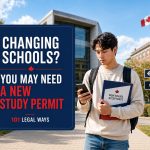
What Happens If You Change Schools?
A study permit holder who wants to change post-secondary DLIs must follow the current IRCC process.
IRCC’s study permit conditions state that a student must apply to extend their study permit when changing post-secondary schools. Simply updating an online account or beginning at a different school may not satisfy the current requirements.
School changes can also create different enrolment records. Keep documents showing:
- When studies ended at the former DLI
- When the new school accepted you
- When the new program began
- The study permit extension application
- Any gap between the two programs
Can Compliance Problems Affect Working in Canada?
Yes. Student work authorization is tied to specific eligibility requirements and study permit conditions.
A student who stops studying, takes an unauthorized leave or becomes ineligible to work must not assume that the printed work condition on the study permit continues to authorize employment.
Working when not authorized may affect:
- Student status
- Future study permit applications
- Work permit applications
- PGWP eligibility
- Permanent residence applications
Students should verify their current work eligibility whenever their course load, enrolment or academic status changes.
Possible Consequences of Non-Compliance
If IRCC determines that a student did not follow the study permit conditions, the consequences can be serious.
The student may:
- Lose student status or the study permit
- Be asked to leave Canada
- Become subject to a removal order
- Have to wait six months before applying for a new study permit, visitor visa or work permit from inside Canada
- Face problems in future temporary or permanent residence applications
- Face additional consequences for unauthorized work
A school’s report does not by itself decide the outcome of every case. IRCC considers the available records and the student’s circumstances. However, inconsistent records or unexplained gaps may lead to further review.
Common Mistakes to Avoid
Assuming enrolment alone is enough
Students must also make progress toward completing their courses.
Ignoring changes in course load
Dropping courses may change the status recorded by the DLI.
Relying only on informal emails
Obtain official school records whenever possible.
Taking a break without approval
A personal absence is not automatically an authorized leave.
Continuing to work after stopping studies
Work authorization may end when the student no longer meets the applicable requirements.
Sending incomplete records
Respond to each part of the IRCC request and explain any missing document.
Missing the response deadline
Check the request carefully and act promptly. If a document is unavailable, provide an honest explanation and evidence showing the steps taken to obtain it.
A 101 Legal Ways Educational Example
After reading 101 Legal Ways guides, Samuel realized that a scheduled academic break and a part-time semester were not the same.
He reviewed his school account and noticed that one semester had been recorded differently from what he expected. Instead of waiting for a future immigration application, Samuel contacted the registrar, requested an official transcript and obtained written confirmation of his status.
He also kept his leave approvals, registration records and tuition receipts together in one secure folder.
This is a fictional public education example. Samuel is not a real client and the scenario does not guarantee any immigration result. It demonstrates how understanding compliance rules can help a student maintain better records and make more informed decisions.
101 Legal Ways provides accessible public education about Canadian laws and immigration processes. The platform helps readers understand official information, identify important questions and prepare for conversations with their school or an authorized professional.
Four Actionable Takeaways
- Check your recorded status every semester. Confirm whether your DLI considers you full-time, part-time, on leave or no longer enrolled.
- Keep official academic records. Save enrolment letters, transcripts, leave approvals and documents showing changes to your studies.
- Respond carefully to IRCC. Follow the instructions, meet the deadline and provide documents that directly address the request.
- Review your work and PGWP eligibility after any academic change. A reduced course load, leave or withdrawal may affect more than your study permit.
Final Thoughts
Compliance reporting is now a regular part of Canada’s International Student Program. It allows IRCC to compare study permit conditions with the enrolment information held by post-secondary DLIs.
Students should not treat recordkeeping as something needed only after a problem occurs. Confirming your status, documenting approved changes and keeping accurate academic records can make it easier to respond if IRCC asks questions later.
Immigration rules and reporting procedures can change. Always review the latest IRCC instructions before making decisions about your studies, work or status in Canada.
Official Government Sources
- IRCC: Study permit conditions
- IRCC: Student compliance reporting
- IRCC: DLI student compliance reporting guide
Legal Disclaimer
This article provides general public legal and immigration information only. It is not legal advice and does not create a lawyer-client or consultant-client relationship. Immigration rules, school policies and individual circumstances may change. Consult IRCC, your designated learning institution or an authorized Canadian immigration professional for advice about your specific situation. Information was reviewed against official IRCC guidance available on August 4, 2026.