



















Minor Children of International Students: Do They Need a Canadian Study Permit in 2026?

Moving to Canada for school can affect the entire family. Parents may need to arrange housing, finances and their own studies while also making sure their children can attend school legally.
One of the most confusing questions is whether a minor child needs a separate study permit.
The answer depends on several factors, including whether the child is applying from outside Canada, whether the child is already in Canada and what type of immigration status the parent holds.
This 101 Legal Ways guide explains the current IRCC rules in simple language.
A Realistic Scenario: Priya and Leena
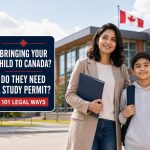
Priya was accepted into a two-year graduate program in Canada. She planned to bring her 10-year-old daughter, Leena.
Priya had heard that children of international students could attend school without study permits. She assumed Leena only needed a visitor visa.
While preparing their applications, Priya learned that timing and location mattered. Because Leena was outside Canada and planned to enter with a parent applying for a study permit, she was expected to apply for her own study permit before travelling.
In this situation, IRCC did not require Leena to have a school letter of acceptance when the child’s application was submitted with the parent’s study permit application.
Priya and Leena are fictional, but their situation shows why families should not rely on a general statement that minor children can study without permits.
Who Is Considered a Minor Child?
The age of majority is determined by each province or territory.
A person is considered a minor until reaching the applicable age of majority.
Age of Majority Is 18
The age of majority is 18 in:
- Alberta
- Manitoba
- Ontario
- Prince Edward Island
- Quebec
- Saskatchewan
Age of Majority Is 19
The age of majority is 19 in:
- British Columbia
- New Brunswick
- Newfoundland and Labrador
- Northwest Territories
- Nova Scotia
- Nunavut
- Yukon
When a child reaches the age of majority, the special rules for minors may no longer apply. A student who wants to continue studying should make sure they obtain the required study permit before losing eligibility under a minor-child exemption.
Official source: IRCC guidance for minors studying in Canada
The Main Rule: Location and Timing Matter
A child coming to Canada from another country is treated differently from a child who is already legally inside Canada.
This is where many families become confused.
| Child’s situation | Is a study permit generally required? |
|---|---|
| Coming to Canada with a parent who has or is applying for a study or work permit | Yes, the child should apply before entering Canada |
| Coming to Canada with a parent who will only have visitor status | Yes |
| Coming to Canada without a parent | Yes |
| Already in Canada with a parent authorized to work or study | Not generally required for preschool, primary or secondary school, but IRCC recommends getting one |
| Already in Canada without either parent | Not generally required for preschool, primary or secondary school, but valid temporary status is still needed |
| Child of a Canadian citizen or permanent resident | No |
| Child who is a refugee claimant or whose parent is a refugee or refugee claimant | No |
| Child taking a course lasting six months or less | Generally no |
These are general rules. A child’s status, location and family circumstances should be reviewed together.
Children Applying From Outside Canada
Minor children who want to study in Canada for more than six months should generally apply for a study permit before entering Canada.
This includes children travelling with parents who are applying for:
- Study permits
- Work permits
The child needs a separate application. Approval of the parent’s permit does not automatically issue a study permit to the child.
When a child applies from outside Canada at the same time as a parent applying for a study or work permit, IRCC says a letter of acceptance is not required for the child’s study permit application.
The family should still be prepared to explain:
- The child’s age
- The intended level of education
- The family relationship
- Who will care for the child
- How the family will pay its expenses
- Where the family expects to live
- The parent’s proposed study or employment in Canada
A child may also require a temporary resident visa or electronic travel authorization depending on their citizenship and travel circumstances.
Official source: IRCC’s minor-child study permit instructions
Children Already in Canada
A minor child already in Canada may attend preschool, primary school or secondary school without a study permit when the child has a parent who is authorized to work or study in Canada.
This may include a parent who holds:
- A valid work permit
- A valid study permit
- Another form of authorization to work without a work permit in an eligible situation
A child already in Canada without a parent may also be permitted to attend preschool, primary school or secondary school without a study permit.
However, studying without a permit does not mean the child can remain in Canada without valid immigration status.
A child who does not hold a study permit may need valid visitor status, such as:
- A visitor record
- A valid Canadian entry stamp
- Another document confirming temporary resident status
The child’s right to attend school and the child’s right to remain in Canada are related but separate issues.
Official source: Who can study in Canada without a study permit
Why Apply If a Study Permit Is Not Required?
IRCC recommends that many minor children obtain study permits even when an exemption allows them to study without one.
A valid study permit may help the child:
- Continue studying when they are no longer a minor
- Obtain a secondary school co-op work permit if eligible
- Access certain social services in some provinces or territories
- Maintain clearer documentation of their authorization to study
- Move between education levels more easily
A study permit may also make it easier to demonstrate the child’s status to a school, although admission and fee decisions are made under provincial, territorial and school-board rules.
Families should not assume that being allowed to study without a permit guarantees free public-school admission.
Is a Letter of Acceptance Required?
The letter-of-acceptance rule depends on where and how the child applies.
Applying From Outside Canada With a Parent
When a minor child applies from outside Canada with a parent who is applying for a study or work permit, IRCC says a letter of acceptance is not required for the child’s study permit application.
Applying Separately
A child applying separately will generally need a letter of acceptance from the Canadian educational institution they plan to attend.
Applying From Inside Canada
A child already in Canada may need a letter of acceptance when applying for a study permit.
IRCC specifically states that a letter is required when:
- The child is in Canada with a family member
- That family member’s work or study permit was approved before the family entered Canada
Extending a Child’s Study Permit
A minor child needs a letter of acceptance to extend a study permit from inside Canada.
The validity period of the new permit may be based on the letter of acceptance.
Do Minor Children Need a PAL or TAL?
Primary and secondary school students from kindergarten to Grade 12 are exempt from the provincial or territorial attestation letter requirement in 2026.
This means a minor applying for a primary or secondary school study permit does not normally need a PAL or TAL.
The exemption does not remove the need for:
- A study permit application when required
- Proof of identity
- Evidence of care and support
- Sufficient financial support
- A valid travel document
- Medical or admissibility documents when requested
Quebec may also have separate provincial immigration requirements that should be checked before applying.
Official source: IRCC’s 2026 student-cap and PAL or TAL exemptions
Custodianship Requirements
Parents or legal guardians must show that a minor child will receive proper care and support in Canada.
A child under 17 must generally:
- Travel with a parent or legal guardian
- Have a custodian in Canada
A custodian is a responsible adult who is a Canadian citizen or permanent resident and agrees to care for the child.
For children aged 17 or older, a custodian is generally optional. An immigration officer may still request one depending on the child’s age, maturity and circumstances.
To appoint a custodian, the family must submit the Custodianship Declaration form.
The form has two similar pages:
- The custodian signs the first page and has it notarized in Canada
- The parents or legal guardians sign the second page and have it notarized in their home country
Custodianship documents should be completed carefully. Missing signatures or improper notarization may create delays.
How Long Is a Minor Child’s Study Permit Valid?
IRCC states that study permits for primary school students are generally issued for one year and can be renewed.
Study permits for secondary school students may be issued for the intended period of secondary study, up to a maximum of four years.
Secondary school generally means:
- Grades 9 to 12 outside Quebec
- Grades 9 to 11 in Quebec
The actual validity period depends on the child’s application, passport, letter of acceptance and family circumstances.
A child’s permit should not be assumed to remain valid simply because the parent receives a new permit.
Extending a Child’s Study Permit
IRCC recommends applying to extend a minor child’s study permit at least 90 days before it expires.
An extension application normally requires:
- A current letter of acceptance
- A valid passport
- A copy of the existing study permit
- Evidence of the parent’s current immigration status
- Proof of the family relationship
- Updated custodianship documents if applicable
- Other documents requested by IRCC
Submitting an extension before the existing permit expires may allow the child to maintain legal status while waiting for a decision, provided the applicable requirements are met.
What Happens If the Child’s Permit Expires?
If a study permit expires before an extension application is submitted, the child may lose temporary resident status.
IRCC generally allows 90 days to apply for restoration of status.
A minor child may continue attending preschool, primary school or secondary school during the restoration period, but restoration is not guaranteed. The family should act quickly and follow the current IRCC instructions.
If the child is studying under an exemption rather than a study permit, the child must still maintain valid visitor status.
What Happens When the Parent’s Status Changes?
A child’s ability to study without a permit may depend on the parent remaining authorized to work or study in Canada.
Families should review the child’s situation when the parent:
- Finishes school
- Receives a Post-Graduation Work Permit
- Changes from student to visitor
- Loses temporary resident status
- Leaves Canada permanently
- Receives permanent residence
- Extends or changes a work permit
For example, a parent moving from a valid study permit to a valid work permit may continue to be authorized to work in Canada. However, the child’s own visitor record or study permit still needs to remain valid.
Do not assume the child’s immigration documents automatically change when the parent receives a new permit.
What Happens When the Child Becomes an Adult?
A child who reaches the age of majority must generally obtain a study permit to continue studying.
The age is 18 or 19 depending on the province or territory.
Families should prepare the application before the child reaches that age. Waiting until after the birthday may interrupt the child’s authorization to study or create a status problem.
A student moving from secondary school to college or university must also satisfy the requirements that apply to post-secondary students.
Common Mistakes Families Should Avoid
Common sources of confusion include:
- Assuming the parent’s permit automatically covers the child
- Applying from outside Canada without a separate child application
- Confusing a study-permit exemption with immigration status
- Allowing the child’s visitor record to expire
- Forgetting that the age of majority differs by province
- Submitting incomplete custodianship documents
- Assuming a school admission decision replaces IRCC authorization
- Failing to apply for an extension at least 90 days before expiry
- Assuming the child automatically receives the same status as the parent
- Using outdated PAL or TAL information
A 101 Legal Ways Educational Example
After reading 101 Legal Ways guides, Sarah realized that her son Mateo’s situation depended on whether he was applying from outside Canada or was already inside the country.
Instead of assuming that her study permit would automatically cover him, she prepared a separate study permit application for Mateo. She also checked that primary and secondary students were PAL-exempt and collected documents showing their relationship and financial arrangements.
Sarah and Mateo are fictional public-education examples. They are not clients and their story does not promise approval or a particular immigration result.
101 Legal Ways helps families understand official requirements, identify important deadlines and prepare better questions before applying.
Four Actionable Takeaways
- Identify whether the child is applying from outside or inside Canada. The study-permit rules are different.
- Submit a separate child application when required. A parent’s study or work permit does not automatically issue immigration status to the child.
- Protect the child’s temporary status. Monitor the study permit, visitor record and passport expiry dates.
- Prepare for custodianship and age changes. Arrange proper care documents and apply for a study permit before the child reaches the age of majority.
Final Thoughts
Minor children may sometimes attend school in Canada without study permits, but that exemption should not be misunderstood.
Children coming to Canada normally need to apply before entering, including children travelling with parents applying for work or study permits. Children already in Canada may qualify for an exemption, but they must still maintain valid temporary resident status.
Families should review both the parent’s status and the child’s documents before travelling, enrolling in school or applying for an extension.
Legal Disclaimer
This article provides general public legal and immigration information only. It is not legal advice and does not create a lawyer-client, consultant-client or other professional relationship. Immigration requirements, forms, fees and procedures can change without notice. School admission, tuition and residency rules may also vary by province, territory and school board. Always review current IRCC instructions and obtain advice from a Canadian lawyer or properly authorized immigration representative for your specific circumstances.