



































Passport Expiry and Canadian Study Permits: What Happens If Your Passport Expires Before Your Program Ends?

An international student may be admitted to a two-year or four-year Canadian program while holding a passport that expires much sooner. This can affect the length of the study permit, the timing of an extension and the student’s ability to travel.
A renewed passport does not automatically extend a study permit. A study permit does not renew a passport, and neither document replaces the visitor visa or electronic travel authorization that may be needed to return to Canada.
Consider Amina, a fictional student accepted into a two-year Canadian diploma program. Her passport was valid for only 14 more months. She assumed her study permit would cover the entire program because her letter of acceptance showed a two-year completion date.
When Amina received her permit, its expiry date was linked to the limited validity of her passport. She later renewed the passport but believed the new passport automatically added time to her existing study permit. It did not. She still needed to apply for a study permit extension before the date printed on the permit.
This guide explains how passport expiry interacts with study permits, extensions, maintained status, restoration, visitor visas, eTAs and post-graduation work permit planning. It provides general public information only and does not guarantee an immigration outcome.
The Four Documents Students Commonly Confuse
International students should separate four different documents:
| Document | Main purpose | Key expiry issue |
|---|---|---|
| Passport or travel document | Establishes identity and nationality and permits international travel | Canadian immigration documents generally cannot be issued beyond the passport validity that applies to the decision |
| Study permit | Authorizes study and sets temporary-resident conditions in Canada | The student must stop studying when it expires unless they applied in time and are legally continuing under maintained status |
| Visitor visa or temporary resident visa | Allows a visa-required traveller to travel to a Canadian port of entry | It may expire on a different date from the study permit |
| Electronic travel authorization | Allows an eligible visa-exempt traveller to fly to or transit through Canada | It is electronically linked to one passport; a new passport requires a new eTA |
A valid study permit is not a travel document. It does not by itself allow a student to board a flight to Canada or guarantee re-entry.
Similarly, a valid visitor visa or eTA does not authorize study. It allows travel to a port of entry, where a border services officer makes the admission decision.
Can a Study Permit Be Extended Beyond the Passport Expiry Date?
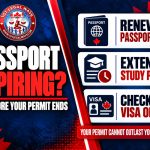
No. IRCC specifically warns students to make sure their passports do not expire at the same time as their study permits because a study permit cannot be extended beyond the passport’s expiry date.
This means a student requesting an extension for another two years may receive a much shorter permit if the passport expires in eight months.
The practical order is usually:
- Check the passport expiry date.
- Renew the passport early enough, where possible.
- Apply for the study permit extension using the new passport.
- Submit the application before the current study permit expires.
Passport-renewal procedures and timelines depend on the student’s country of citizenship. Canadian immigration authorities do not renew foreign passports. Students must follow their government’s embassy, consulate or passport-authority process.
What Does Canadian Law Say About Study Permit Expiry?
Under section 222 of the Immigration and Refugee Protection Regulations, a study permit becomes invalid on the first applicable date, including:
- Ninety days after the student completes the studies, subject to limited exceptions
- The day the student is no longer enrolled at the designated learning institution named in the permit, other than because the student completed the studies
- The day the permit is cancelled under the applicable provisions
- The expiry date printed on the permit
Students should therefore read the date on the study permit itself. The expected graduation date, expiry date on the visitor visa, passport expiry date and permit expiry date may all be different.
IRCC’s study permit extension page says the expiry date on the permit tells the student when they must stop studying and leave Canada, unless they have taken an authorized step to extend or change their status.
Before Applying for the First Study Permit
Before submitting an initial study permit application, compare the passport validity with:
- The program start date
- The expected program completion date
- The likely travel date
- Any required medical or biometric timelines
- The time the passport authority needs for renewal
Where renewal is available, obtaining a longer-valid passport before applying may reduce the need for an early study permit extension.
Do not enter a false passport expiry date or submit altered passport pages to obtain a longer permit. The application must contain the real passport information.
If renewal is not yet allowed under the issuing country’s rules, the applicant can explain the situation and apply with the valid passport they have. Approval and permit length remain decisions for Canadian immigration authorities.
What if the Passport Expires While the Study Permit Application Is Processing?
IRCC says applicants must keep information in an application up to date. A new passport is specifically listed as a change that must be reported.
If the student receives a new passport while an application is still in progress, they should use IRCC’s current application-update instructions and submit the new passport information and a clear copy of the biographical page through the web form, unless IRCC has provided different instructions for the particular application.
The update should identify:
- The applicant’s full name
- Date of birth
- Unique client identifier, if available
- Application number
- Old passport number
- New passport number
- New issue and expiry dates
- A short explanation that the passport was renewed during processing
The student should keep proof that the update was submitted. Sending an update does not guarantee that it will be reviewed before a decision, particularly if it is sent very late.
Review the official IRCC application-update instructions.
What if the Study Permit Was Approved Before the Passport Was Renewed?
Students applying from outside Canada normally receive a port of entry letter of introduction after approval. That letter is not the study permit. The actual permit is issued at the port of entry if the student continues to meet the requirements.
If the student renews the passport after approval but before travelling, they should carefully review the approval letter and current IRCC instructions. The travel document connected to the approval may also be affected.
At minimum, the student should carry:
- The new valid passport
- The old passport, where available
- The port of entry letter of introduction
- A copy of the letter of acceptance
- Any required visitor visa or eTA connected to the correct travel document
- Documents explaining any legal name change
The student should not assume that an eTA linked to the old passport transferred to the new one. It does not.
A New Passport Requires a New eTA
IRCC states that an eTA is electronically linked to the passport used in the application. When the traveller receives a new passport, they must obtain a new eTA.
An airline checks the passport electronically. An eTA linked to the cancelled or expired passport will not normally match the new passport presented for travel.
Students from eTA-required countries should:
- Renew the passport.
- Apply for a new eTA using the new passport information.
- Confirm the approval before travelling.
- Travel with the same passport used for the new eTA.
Do not enter the old passport number when applying for the new eTA.
Review IRCC’s official guidance on new passports and eTAs.
What About a Valid Visitor Visa in the Old Passport?
IRCC currently says a person may travel to Canada using a valid visa in an old passport if they bring both:
- The old passport containing the valid visa
- The new valid passport or travel document
The traveller may need to explain why the old passport is no longer valid. IRCC recommends obtaining a new visa in the valid passport to avoid delays at the border.
Before relying on the old visa, confirm that:
- The visa has not expired
- The old passport has not been reported lost or stolen
- The personal details remain consistent
- Any legal name change is properly documented
- The airline and transit-country requirements can also be met
A Canadian visitor visa does not override another country’s transit rules. A student changing flights outside Canada may need separate transit authorization.
Review IRCC’s guidance on using a valid visa in an old passport.
Renewing a Passport While Studying in Canada
Renewing the passport does not cancel a still-valid study permit merely because the passport number changes. However, the student must continue to follow the expiry date and conditions printed on the permit.
After receiving the new passport:
- Check the current study permit expiry date
- Apply for an extension if more time is needed
- Use the new passport details in the extension application
- Keep the old passport and copies of both passports
- Check whether a new eTA or visitor visa is needed before travel
- Update any pending IRCC application
- Check provincial documents that may also expire
Do not write on or alter the study permit. Keep the original document safely.
When Should a Student Apply to Extend the Study Permit?
IRCC instructs students who want to continue studying at the same school to apply at least 30 days before the study permit expires. The passport should be renewed early enough to support the requested extension period.
Thirty days is a minimum recommendation, not a guarantee of a decision before expiry. Students should begin planning earlier because passport renewal itself can take time.
A practical timeline may include:
- Six to twelve months before passport expiry: Check whether renewal is permitted and what documents are required.
- Several months before study permit expiry: Obtain the new passport and request current enrolment documents from the school.
- At least 30 days before permit expiry: Submit a complete study permit extension application.
- Before travelling: Check the passport, study permit, visa or eTA and destination or transit requirements.
The exact timeline depends on the passport authority, IRCC processing and the student’s circumstances.
Review IRCC’s study permit extension timing instructions.
Documents Commonly Needed for the Extension
The personalized document checklist controls the application, but students may need documents such as:
- New valid passport
- Current study permit
- Letter of acceptance or enrolment from the designated learning institution
- Academic transcripts or proof of progress
- Proof of financial support
- Explanation of why more time is needed
- Provincial or territorial attestation letter where required
- Proof of an exemption from the PAL or TAL requirement, where applicable
- Quebec authorization documents for studies in Quebec
- Evidence of any legal name change
IRCC states that post-secondary students must upload the letter provided by the DLI in the LOA-specific space. The institution will be asked to verify it.
Under the current rules, a student extending at the same designated learning institution and the same level of study may fall within a PAL or TAL exemption. Changing schools or levels can require a new PAL or TAL unless another exemption applies. Students should check the latest requirements immediately before applying.
What Is Maintained Status?
If a student applies to extend or change the conditions of the study permit before it expires, they are legally allowed to remain in Canada while IRCC processes the application.
IRCC also states that a student who applied before expiry can generally continue studying under the same conditions as the current permit while awaiting a decision, provided the student remains in Canada.
This is commonly called maintained status.
Keep evidence showing:
- The application was submitted before expiry
- The submission date and time
- The fee payment
- A copy of the complete application
- The current permit and passport
Maintained status does not create a new travel document. Leaving Canada while the application is pending can affect the student’s ability to continue studying under the same conditions and to re-enter. Students considering travel should review current IRCC instructions carefully before departure.
IRCC also warns that people on maintained status may be unable to renew certain provincial documents, including a driver’s licence or health card, and may face limitations involving the Social Insurance Number record.
What if the Study Permit Expires Before the Extension Is Filed?
The student loses student status if the study permit expires before a new application is submitted.
IRCC states that once status is lost, the person cannot study until student status has been restored and a new study permit has been received. Filing a late restoration application does not authorize continued study while it is processed.
Under section 182 of the Immigration and Refugee Protection Regulations, an eligible visitor, worker or student may apply for restoration within 90 days after losing temporary resident status, subject to the regulatory requirements.
An eligible student seeking restoration must generally:
- Apply for a new study permit
- Apply to restore temporary resident status
- Submit the required documents
- Explain why restoration is required
- Pay the applicable fees
- Stop studying until restoration and the new permit are approved
Restoration is not automatic. If the student is outside the restoration period or does not qualify, different options may apply and professional advice may be appropriate.
Review IRCC’s official expired study permit and restoration guidance.
Can the Student Travel While the Passport or Permit Is Near Expiry?
Travel should be planned using the earliest relevant expiry date.
Before leaving Canada, check:
- Passport validity for the entire trip
- The destination country’s entry requirements
- Transit-country requirements
- Study permit validity on the planned return date
- Visitor visa validity, if required
- eTA linked to the passport being used, if required
- School enrolment and return-to-study documents
- Whether an extension application is pending
IRCC confirms that a study permit is not a travel document. Having the required passport and visa or eTA also does not guarantee re-entry. The border services officer must still be satisfied that the traveller meets the requirements.
A student should not leave Canada assuming that an online extension-submission receipt will replace an expired study permit or travel document at the border.
Review IRCC’s official guidance on international student travel.
Passport Expiry and Post-Graduation Work Permits
Passport planning remains important near graduation.
IRCC states that the length of a post-graduation work permit depends partly on the passport expiry date. A PGWP will be issued only for the period during which the passport is valid.
If the applicant was eligible for a longer PGWP but received a shorter one solely because the passport was going to expire, IRCC permits an application to extend the PGWP after the passport is renewed. That extension must be submitted on paper under the current instructions.
Students should therefore check passport validity well before applying for a PGWP. A passport valid for only a few additional months may result in a short initial work permit and another application.
PGWP eligibility is not automatic. The student must still satisfy all applicable institution, program, study, language and application requirements.
Review IRCC’s PGWP validity and passport guidance.
Special Passport Situations
Lost or Stolen Passport
Report the loss to the appropriate local authorities and the passport-issuing authority. Follow the issuing country’s procedure for a replacement. Keep the police report or loss report and document the change in any pending Canadian immigration application.
Damaged Passport
A damaged passport may not be accepted for travel even if the printed expiry date has not passed. Seek instructions from the issuing authority and avoid making travel plans until valid documentation is available.
Legal Name Change
If the new passport shows a different legal name, retain the marriage certificate, divorce record, legal change-of-name certificate or other official evidence. Use the correct IRCC procedure to update the application or record.
Dual Citizenship
Do not casually switch passport information during an active application. The passport used can affect visa or eTA requirements. Report the change accurately and follow the instructions applicable to both citizenship and travel documents.
Venezuelan Passports
IRCC provides special application instructions for some Venezuelan passports whose printed expiry dates have passed. These rules are specific and may change. Applicants should use the current IRCC instructions rather than assuming the same treatment applies to another country’s passport.
Common Mistakes to Avoid
Assuming the New Passport Extends the Study Permit
It does not. The student must apply for the required extension before the current permit expires.
Looking Only at the Program End Date
The school’s expected completion date does not replace the permit expiry date.
Confusing a Study Permit With a Visitor Visa
The study permit authorizes study and status conditions. The visitor visa or eTA supports travel to Canada.
Travelling With an eTA Linked to the Old Passport
A new passport requires a new eTA.
Renewing the Passport Too Late
Waiting can leave too little time to submit a complete extension application before the permit expires.
Continuing to Study After Losing Status
A late restoration application does not authorize study while IRCC processes it.
Discarding the Old Passport
The old passport may contain a valid visa or help explain the connection between older and newer documents.
Forgetting to Update a Pending Application
IRCC lists a new passport as information that must be reported in an application that is still being processed.
Ignoring Passport Validity Before a PGWP Application
A short-validity passport can shorten the initial PGWP.
A 101 Legal Ways Educational Example
After reviewing 101 Legal Ways guides, Amina stopped treating her renewed passport as an automatic extension of her status.
She checked the expiry date printed on her study permit and began her passport renewal several months before that date. When the new passport arrived, she used its details in a complete study permit extension application filed before the existing permit expired.
Amina saved proof of submission and remained in Canada while IRCC processed the application. Before planning a trip, she checked her visitor visa separately. She also reviewed the passport’s validity against her expected graduation and possible PGWP application date.
Amina is fictional and is not a real client. This example does not guarantee approval or mean every student will need the same documents. It demonstrates why passport, permit and travel-document expiry dates must be managed separately.
101 Legal Ways provides practical public education about Canadian laws and immigration procedures. Its guides help readers understand official requirements, organize documents and ask better questions before taking important steps.
Four Actionable Takeaways
- Check every expiry date separately. A passport, study permit, visitor visa and eTA serve different purposes.
- Renew the passport before requesting a long extension. A study permit cannot be extended beyond the passport’s expiry date.
- Apply before the study permit expires. A timely application may allow the student to remain and continue studying under maintained status while staying in Canada.
- Review travel and PGWP consequences. A new passport requires a new eTA, and short passport validity can shorten a PGWP.
Final Thoughts
Passport expiry is not only a travel issue. It can determine how long a study permit or post-graduation work permit is issued, when an extension must be filed and which documents a student needs to return to Canada.
The safest approach is to plan early. Compare the passport expiry date with the permit, program, visa or eTA and expected graduation. Renew the passport when eligible, update pending applications and submit extension requests before status expires.
A new passport changes the travel document. It does not automatically change the expiry date on an existing study permit. Always follow the current instructions that apply to the specific document and situation.
Official Government Sources
- IRCC: Extend your study permit or restore your status
- IRCC: When to apply for a study permit extension
- IRCC: How to apply for a study permit extension
- IRCC: What to do if a study permit expires
- Department of Justice Canada: IRPR section 222
- Department of Justice Canada: IRPR section 182
- IRCC: Update an application with new information
- IRCC: International student travel and re-entry
- IRCC: New passport and eTA requirements
- IRCC: Valid visa in an old passport
- IRCC: PGWP length and passport expiry
Legal Disclaimer
This article provides general public legal and immigration information only. It is not legal advice and does not create a lawyer-client or consultant-client relationship. Immigration rules, passport procedures, institutional requirements and personal circumstances may change. Consult IRCC, the passport-issuing authority, your designated learning institution or an authorized Canadian immigration professional for advice about your specific situation. Information was reviewed against official guidance available on September 16, 2026.