




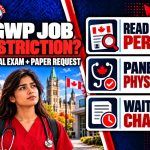














































You have graduated, submitted your post-graduation work permit (PGWP) application and started working. Then a family event or an important trip takes you outside Canada. Can you come back and return to work while Immigration, Refugees and Citizenship Canada (IRCC) is still processing the application?
IRCC says an eligible applicant can leave and re-enter Canada after applying for a first PGWP and continue working full-time while awaiting a decision. That answer depends on the facts. A valid passport and any required visitor visa or electronic travel authorization (eTA) remain essential for travel. The border officer decides whether to admit the person. The applicant must also have qualified to work while the PGWP application was pending in the first place.
Consider Arjun, a fictional graduate who submitted his PGWP application before his study permit expired. He had complied with the off-campus work rules during his program. While his application was pending, he travelled to see family. His study permit expired before his return flight, but his visitor visa remained valid. He carried his passport, old study permit, graduation proof and PGWP application receipt. He needed to understand why he might enter as a visitor yet still be allowed to work while IRCC decided his first PGWP application.
This guide explains the distinction among travel permission, admission to Canada and work authorization. It also identifies a different rule for people applying to extend an already issued PGWP because their passport limited its length. It is general public information, not a promise of admission or approval.
The Short Answer: Can You Travel While Waiting for a PGWP?
Yes, you may leave Canada while a PGWP application is pending. IRCC’s PGWP travel answer says that you can return if your required visa or eTA is valid, subject to the officer’s examination at the border.
IRCC’s after-you-apply guidance also says that leaving and re-entering Canada after applying for a PGWP does not, by itself, stop an otherwise eligible applicant from working full-time while waiting for a decision.
Those statements do not mean every traveller will be admitted or every PGWP applicant can work. Check three separate questions:
- Can you board and travel? You need a valid passport and, depending on your nationality and mode of travel, a valid visitor visa or eTA.
- Can you enter Canada? A border services officer assesses admissibility and the purpose and conditions of your stay.
- Can you work after you return? Your eligibility depends on the rules for interim work authorization and whether IRCC has decided the PGWP application.
Your Study Permit or PGWP Is Not a Travel Document
A study permit and a work permit regulate what you may do in Canada. Neither replaces a required visa or eTA for travel back to Canada.
Before buying tickets, confirm:
- Your passport will be valid for the trip and return.
- Your visitor visa, if required, will still be valid when you seek to return.
- Your eTA, if required for air travel, is valid and linked to the passport you will use.
- You have documents explaining your current application and plans in Canada.
- You meet ordinary entry requirements.
An unexpired visa or eTA allows travel to a port of entry; it does not guarantee admission. An approved PGWP likewise does not substitute for an expired visitor visa. IRCC says a person who applies for a PGWP inside Canada and needs a visa is not automatically issued a new visa when the PGWP is approved. That person must apply separately for a new visitor visa if the existing one has expired and travel is planned.
IRCC says it will issue a new visa or eTA when it approves a PGWP application made outside Canada. For an inside-Canada PGWP application, IRCC says it will issue an eTA on approval when one is needed for air travel. These statements describe the approval stage; someone travelling while an application is still pending should verify their actual travel authorization before departure.
What Happens at the Border While the First PGWP Is Pending?
IRCC describes three possibilities in its Help Centre answer about pending PGWP travel:
| Situation when you return | How IRCC describes entry | Work position |
|---|---|---|
| Study permit remains valid | You may enter as a student | Interim work still depends on meeting the PGWP work conditions. |
| PGWP was approved while you were away | You may enter as a worker | Follow the issued permit and its conditions. |
| Study permit was valid when you applied and PGWP remains pending | You may enter as a visitor | You may work without a work permit until IRCC decides the PGWP if the interim work conditions apply. |
The phrase “enter as a visitor” in the third row can be confusing. It describes the basis on which the officer may admit a person whose study permit has expired and whose new permit remains pending. IRCC specifically says that a qualifying first PGWP applicant in this situation may still work without a permit until a decision is made.
The border officer can ask questions and request evidence that you applied. IRCC gives the application copy or fee receipt as examples. The officer may refuse entry if the entry requirements are not met. Keep your account information accessible while travelling so you can check whether the application has been approved, refused or returned.
Who Can Work While Waiting for the First PGWP?
According to IRCC’s PGWP after-you-apply page, you can work full-time while awaiting a decision if, when you submitted the application, you:
- Had a valid study permit
- Had completed your study program
- Were eligible to work off campus without a work permit while studying
- Had not exceeded the permitted off-campus work hours
IRCC’s Help Centre answer currently refers to the 24-hour weekly limit during academic sessions. Check the rules that applied during your own study period and your records. The central point for this travel question is that a trip does not create work authorization if you were never eligible for it.
If those conditions did not apply when you filed, wait until you have work authorization before working. A person who applied after their study permit expired, for example, cannot assume that merely submitting a PGWP application permits immediate work. IRCC’s application instructions address restoration and explicitly say that a study permit must have been valid when the PGWP application was submitted for work while awaiting a decision.
Does the 180-Day Date on a PGWP Work Letter End Your Work Rights?
Some applicants receive the WP-EXT for PGWP (IMM 0127 E) letter with a 180-day validity date. IRCC says that if you qualify to work while awaiting the PGWP, you may continue until a decision even when that date has passed. You can request proof of continuing authorization through IRCC’s web form if needed.
The letter is useful evidence for an employer, but the date on it should be read with IRCC’s current guidance. It is also not a visa or travel document. Keep the letter with the rest of your evidence, and verify that the underlying PGWP application remains pending.
If IRCC refuses the PGWP, the interim work authorization ends when you are notified. IRCC also says a rejected application requires the person to stop working as soon as notified. Travel does not extend a work right after an adverse decision.
Documents to Carry on the Return Trip
The right set depends on the traveller, but a practical file may contain:
- Valid passport and required visitor visa or eTA details
- Study permit, even if it expired after the PGWP filing
- Graduation completion letter or official transcript
- PGWP application confirmation or acknowledgement of receipt
- Application copy and fee payment receipt
- WP-EXT for PGWP letter, if issued
- Evidence of the current Canadian address and employment, where relevant
- Any PGWP approval notice or permit issued while away
IRCC says the border officer may ask for proof of the PGWP application. For an employer, its document guidance identifies graduation proof, the study permit, the application acknowledgement and the WP-EXT letter if received. Carrying those records makes it easier to explain your timeline, but no collection of papers guarantees admission.
Make sure dates match: when the school confirmed completion, when the application was submitted, when the study permit expired, and when you left and returned. If you have changed passports, check whether the visa or eTA rules require action before travel.
What If Your Study Permit Expires While You Are Away?
IRCC’s specific PGWP travel guidance addresses this common situation. If the study permit was valid when the first PGWP application was submitted and the application remains pending, IRCC says you may enter as a visitor and work without a permit until it makes a decision, provided you can re-enter and otherwise meet the work conditions.
Do not assume a study permit that expired before the PGWP application has the same result. The time of filing matters. Nor does an expired visitor visa become valid because the study permit was once valid. The visa or eTA question and the interim work question must both be checked.
What If IRCC Approves or Refuses the PGWP During Your Trip?
Log in to your IRCC account and review messages before travelling home. An application that was pending at departure may have a different status when you reach the border.
If IRCC approves the PGWP while you are away, its travel answer says you may enter as a worker if admitted. Check the permit’s validity and any occupational restrictions. A traveller who needs a visitor visa after an inside-Canada application must still have a valid visa to travel back; PGWP approval alone does not issue one automatically.
If IRCC refuses or rejects the application, stop any work tied to the pending application when notified. The refusal may also change your plan for returning to Canada. Review the decision, your current status and your actual travel authorization before attempting to work or relying on an earlier letter.
If a document request or message arrives during the trip, respond within the deadline. Maintain access to the email and IRCC account used for the application.
A Different Rule: Extending a PGWP Shortened by Passport Expiry
A person who already holds a PGWP may apply on paper to extend it to the full period for which they were originally eligible if the first PGWP was shortened because their passport expired. This is a narrow extension situation, distinct from a graduate waiting for a first PGWP.
IRCC’s pending-PGWP travel answer explicitly says that if such an extension applicant leaves Canada while on maintained status, they may enter as a visitor but cannot work without a work permit until IRCC decides the extension application. Its general work permit renewal travel page likewise warns that a person returning while a renewal remains pending may be admitted as a visitor and cannot work until the renewal is approved.
Do not apply the more favourable travel statement for a first PGWP application to a passport-limited PGWP extension. Check which application you actually filed and whether the old permit remains valid when you return.
Can You Apply for a PGWP at the Airport or Land Border?
No. IRCC says that since June 21, 2024, PGWP applications cannot be made at a port of entry. Its application page permits eligible graduates to apply from inside or outside Canada and generally requires an online application for the first PGWP.
Someone returning to Canada cannot solve an unsubmitted application by asking the border officer to issue a PGWP. A person entering as a visitor who remains eligible may apply from inside Canada according to the applicable instructions, but entry and a later application do not by themselves grant immediate work authorization.
Before You Book: A Travel Checklist
- Confirm the application type. Are you waiting for a first PGWP, or an extension of an already issued PGWP?
- Confirm the original work conditions. Was your study permit valid when you applied, had you finished the program, and were you eligible to work off campus within the allowed limits?
- Check the travel document. Verify passport, visa or eTA validity for the return journey.
- Check your application account. Note any new decision, document request or deadline.
- Pack the timeline evidence. Bring the permit, completion proof, application confirmation, receipt and any work letter.
- Plan for an officer’s questions. Be ready to describe the trip, current application, job and intended stay accurately.
- Recheck the rules before departure. Immigration procedures and your personal circumstances can change between booking and travel.
When travel is urgent and documents are expiring, consider the time needed to obtain a new visa and the possibility that admission may be refused. Employer scheduling and a return ticket do not override immigration requirements.
Common Mistakes
Assuming a Study or Work Permit Replaces a Visa
A permit does not authorize travel to Canada. Verify the required visa or eTA separately.
Assuming Every Pending Applicant Can Work
Interim work depends on the conditions at the time the first PGWP application was submitted. The application receipt alone is insufficient.
Treating Visitor Entry as an Automatic Work Ban for a First PGWP
IRCC specifically describes a qualifying first PGWP applicant whose study permit has expired entering as a visitor and continuing to work until a decision. The person’s underlying eligibility still matters.
Applying the First-PGWP Rule to a PGWP Extension
IRCC states a different work result when a passport-limited PGWP extension applicant leaves while on maintained status and returns before a decision.
Planning to Apply at the Border
PGWP applications at ports of entry ended in June 2024.
Ignoring an IRCC Decision During Travel
An approval, refusal or rejection changes the basis for work. Read account messages before returning and before resuming a job.
A 101 Legal Ways Educational Example
After reading 101 Legal Ways guides, Arjun separated his questions. His visitor visa and passport covered the planned return flight. He confirmed that his study permit was valid when he filed his first PGWP application, that he had completed his program, and that his student work complied with the rules. He saved his completion letter, application receipt, study permit and WP-EXT letter. During the trip, he checked his IRCC account for a decision.
At the border, he accurately explained that his first PGWP remained pending and showed proof of filing when asked. The officer’s decision about admission was still required. Once admitted, Arjun verified that the application remained undecided and used IRCC’s guidance to explain his interim work authorization to his employer.
Arjun is fictional and is not a real client. The example does not promise that another traveller will be admitted or allowed to work. It illustrates why the application timeline and travel authorization must both be documented.
101 Legal Ways provides practical public education about Canadian laws and immigration procedures. Its guides help readers understand official instructions, organize their records and ask better questions before important decisions.
Four Actionable Takeaways
- Check the visa or eTA before departure. A permit and a pending application are not substitutes for travel authorization.
- Confirm interim work eligibility. For a first PGWP, the study permit and work conditions at the time of application are decisive.
- Carry proof and monitor the application. Bring completion and filing records, and check for a decision throughout the trip.
- Identify an extension separately. Leaving on maintained status while a passport-limited PGWP extension is pending can interrupt work rights on return.
Final Thoughts
Travel while a first PGWP application is pending is possible. For a qualifying applicant, IRCC says leaving and re-entering does not by itself end the ability to work full-time while waiting. The return still depends on a valid travel document where required and a border officer’s admission decision.
The most useful preparation is a clear timeline: completion of studies, validity of the study permit when the PGWP was filed, previous student work compliance, the application’s present status, and the documents required to travel back. Applicants extending an existing PGWP should use the rules for that extension, especially when they leave Canada on maintained status.
Read the full article collection at 101 Legal Ways, share your questions in the blog comments and subscribe for more Canadian immigration education.
Official Government Sources
- IRCC Help Centre: Travelling while waiting for a PGWP
- IRCC: PGWP after you apply
- IRCC Help Centre: Working while waiting for a PGWP
- IRCC Help Centre: Evidence for an employer
- IRCC: How to apply for a PGWP
- IRCC: Travel while a work permit renewal is pending
Legal Disclaimer
This article provides general public immigration information only. It is not legal advice and does not create a lawyer-client or consultant-client relationship. Entry decisions, work authorization and PGWP eligibility depend on individual facts and current rules. Check IRCC’s official instructions and seek advice from an authorized Canadian immigration professional for your situation. Information was reviewed against official guidance available on October 5, 2026.