




































Study Permit vs Student Visa: Understanding the Difference Before You Apply

Many international students use the words “student visa” when discussing permission to study in Canada. The phrase is common but it can create confusion because Canada does not issue one document that performs every function.
A study permit authorizes study. A temporary resident visa or electronic travel authorization supports travel to Canada. A port of entry letter confirms that a study permit application made outside Canada was approved.
Mixing up these documents can cause serious problems, especially when a student travels outside Canada or assumes an approval letter is the physical study permit.
This 101 Legal Ways guide explains what each document does, when it is issued and why international students may need more than one document.
Is a Canadian Study Permit the Same as a Student Visa?
No. A Canadian study permit is not a travel visa.
The documents serve different purposes:
| Document | Main purpose | Does it authorize study? | Does it support travel to Canada? |
|---|---|---|---|
| Study permit | Authorizes study in Canada under stated conditions | Yes | No |
| Temporary resident visa | Allows a visa-required traveller to travel to a Canadian port of entry | No | Yes |
| Electronic travel authorization | Allows certain visa-exempt travellers to fly to or transit through a Canadian airport | No | Yes |
| Port of entry letter | Confirms approval of an application made outside Canada | No | Used to obtain the permit at entry |
| Passport | Confirms identity and nationality | No | Required as a travel document |
A student may need several of these documents at the same time.
A Realistic International Student Scenario
Noor is studying at a Canadian university. Her study permit is valid for another year but the temporary resident visa inside her passport has expired.
Noor plans to visit her family during the winter break. She assumes that her valid study permit will allow her to board the return flight and re-enter Canada.
Before purchasing her ticket, Noor checks IRCC’s travel rules. She learns that her study permit is not a travel document. As a visa-required traveller, she generally needs both a valid study permit and a valid temporary resident visa to return to Canada.
Noor postpones her trip until she can review the visitor visa application requirements and confirm that she has the documents needed for her return.
This scenario is fictional and is provided for public education. It is not a real client testimonial and does not guarantee entry or approval.
What Is a Canadian Study Permit?
A study permit is an immigration document that authorizes a foreign national to study at a Canadian designated learning institution.
The permit may include conditions covering:
- The institution the student is authorized to attend
- The student’s level of study
- Whether the student may work
- Whether a medical examination is required for certain employment
- The date the student’s authorized stay ends
- Other conditions specific to the student
A student must continue meeting the conditions of the permit. This generally includes remaining enrolled, actively pursuing studies and making reasonable progress toward completing the program.
The study permit does not:
- Guarantee entry into Canada
- Replace a passport
- Replace a temporary resident visa
- Replace an eTA
- Automatically allow travel back to Canada
- Guarantee permission to work
- Guarantee a post-graduation work permit
- Provide permanent resident status
IRCC directly confirms that a study permit is not a travel document.
What Is Commonly Called a Student Visa?
The term “student visa” is often used informally to describe the temporary resident visa issued to an international student.
Officially, the document is called a temporary resident visa, or TRV. It is also commonly called a visitor visa.
A TRV is an official document placed inside a passport. It shows that the person met the requirements to travel to Canada when IRCC assessed the visa application.
A temporary resident visa may be:
- A single-entry visa or
- A multiple-entry visa
The visa shows an expiry date. The traveller must use it before it expires.
IRCC explains the document on its official visitor visa information page.
Does a Temporary Resident Visa Allow Someone to Study?
A temporary resident visa alone does not normally authorize a person to complete a program that requires a study permit.
The TRV supports travel to a Canadian port of entry. The study permit provides the legal authorization to study.
A person may have a valid TRV but no study permit. In that situation, the visa does not automatically turn the person into an international student.
Some short programs may be completed without a study permit when they meet IRCC’s exemption rules. However, the person must still meet all entry requirements and obey the conditions of their temporary status.
What Is an Electronic Travel Authorization?
An electronic travel authorization, or eTA, is an entry requirement for certain visa-exempt foreign nationals travelling to Canada by air.
An eTA is:
- Electronically linked to the traveller’s passport
- Generally valid for up to five years or until the passport expires, whichever happens first
- Used for air travel or transit through a Canadian airport
- Not a study permit
- Not a work permit
- Not a guarantee of entry
A person who receives a new passport normally needs a new eTA because the authorization is linked to the passport used for the application.
An eTA does not give a person permission to study. IRCC explains this distinction on its eTA information page.
Does Every International Student Need a TRV?
No. The required travel document depends on factors such as:
- The student’s nationality
- The passport or travel document being used
- Whether the student is travelling by air, land or sea
- Whether the traveller is visa-exempt
- Whether a special travel-document rule applies
A visa-required student normally needs a temporary resident visa.
A visa-exempt student travelling by air may need an eTA.
A United States citizen generally does not need a TRV or eTA but must still meet the study permit and entry requirements.
Applicants should use IRCC’s official travel-document tool rather than relying only on advice given to another student.
What Is a Port of Entry Letter of Introduction?
When IRCC approves a study permit application submitted outside Canada, the applicant normally receives a port of entry letter of introduction.
This document may also be called:
- A POE letter
- An introduction letter
- A correspondence letter
- An approval letter
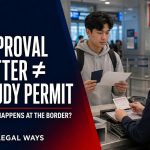
The letter confirms that IRCC approved the application. It is not the physical study permit.
The student presents the letter to a border services officer when arriving in Canada. The officer uses the information in the letter to determine whether the study permit can be issued.
IRCC confirms this on its official port of entry letter information page.
What Happens When a Study Permit Is Approved Outside Canada?
When an application made outside Canada is approved, the student may receive:
- A port of entry letter of introduction
- A temporary resident visa or eTA when required
- Instructions about travelling to Canada
The student does not normally receive the physical study permit before travelling.
At the border, the officer may examine:
- The passport or travel document
- The letter of introduction
- The letter of acceptance
- The temporary resident visa or eTA
- Proof of financial support
- Medical examination validity
- Any updated admission or deferral documents
- Whether the student remains admissible
- Whether the student still intends to attend the approved institution
The officer then decides whether to allow entry and issue the study permit.
IRCC explains this process on its study permit after-application page.
Does Approval Guarantee Entry to Canada?
No document guarantees entry.
A valid TRV or eTA allows a person to travel to Canada and request entry. A border services officer makes the final decision.
The officer must be satisfied that the traveller:
- Has valid travel documents
- Is the person who received the approval
- Is admissible to Canada
- Has sufficient financial support
- Has a valid education purpose
- Continues to meet the study permit requirements
- Will respect the authorized period of stay
- Has not provided false or incomplete information
A student whose situation changed after approval should bring updated documents and be prepared to explain the change.
What Happens When a Student Applies From Inside Canada?
Only certain people are eligible to apply for an initial study permit from inside Canada.
When an eligible in-Canada application is approved, IRCC normally mails the study permit to the Canadian address in the application.
This permit gives the student temporary resident status and authority to study under its conditions. It does not create a new TRV.
If a visa-required student plans to travel outside Canada, they should separately check whether their TRV will remain valid for the return trip.
Can You Travel With Only a Study Permit?
A study permit by itself is generally not enough for international travel and re-entry.
An international student returning to Canada will normally need:
- A valid passport or travel document
- A valid study permit or approval for a study permit or extension
- A valid TRV or eTA when required
- Proof that they attend a designated learning institution
- Evidence that they meet Canada’s other entry requirements
The border officer may also ask for proof of enrolment, financial support or a current letter from the institution.
Current requirements are available on IRCC’s international student travel page.
What If the Study Permit Is Valid but the TRV Is Expired?
A valid study permit lets the student remain and study in Canada under the permit’s conditions. It does not replace an expired TRV for future travel.
A visa-required student who leaves Canada may be unable to board transportation back to Canada without a valid visa.
A limited exception may allow some students to return after travelling only to the United States or Saint-Pierre and Miquelon, provided they return before the end of their authorized stay and meet all other requirements.
Students should not rely on this exception without reviewing the exact IRCC conditions.
What If the TRV Is Valid but the Study Permit Is Expired?
A valid TRV does not extend student status.
The TRV may allow the person to travel to a Canadian port of entry but it does not authorize study after the study permit expires.
A person who remains in Canada after losing student status may need to stop studying and determine whether restoration or another legal option is available.
The expiry dates on the visa and study permit should be tracked separately.
Does Extending a Study Permit Extend the TRV?
No. A study permit extension and a temporary resident visa are different applications serving different purposes.
Extending a study permit may extend authorization to remain and study in Canada. It does not automatically place a new visa inside the student’s passport.
A visa-required student planning international travel should check:
- The study permit expiry date
- The TRV expiry date
- The passport expiry date
- The expected application-processing time
- Whether the student will have the documents required to return
A student should not leave Canada simply because a study permit extension application has been submitted. Travel while an extension remains undecided can affect the student’s ability to continue studying after returning.
Visa Expiry Is Not Always the Same as Status Expiry
The expiry date on a TRV tells the traveller the final date the visa can be used to seek entry.
It does not necessarily show how long the person is authorized to remain inside Canada.
For an international student, authorized status is generally connected to the study permit and any other status document issued by Canadian authorities.
A student can therefore have:
- A valid study permit with an expired TRV
- A valid TRV with an expired study permit
- Different expiry dates on the passport, visa and permit
- An eTA linked to a passport that has since expired
Each document must be reviewed separately.
Common Document Mistakes
International students can face problems when they:
- Refer to every document as a student visa
- Assume the letter of introduction is the study permit
- Travel with an expired TRV
- Assume a study permit guarantees re-entry
- Forget that an eTA is linked to a specific passport
- Replace a passport without checking the eTA
- Confuse a visa expiry date with the end of authorized status
- Assume a valid TRV allows study without a study permit
- Change schools after approval without checking whether a new study permit is required
- Fail to review the permit when it is issued at the border
Check the Study Permit Before Leaving the Airport
When the border officer issues the study permit, the student should check it carefully before leaving the airport or port of entry.
Review:
- The spelling of the name
- The passport number
- The date of birth
- The institution information
- The permit expiry date
- Work authorization wording
- Medical restrictions
- Other conditions
If something appears incorrect, the student should respectfully ask the officer about it immediately.
101 Legal Ways Educational Scenario
After reading 101 Legal Ways guides, Emeka understood that his port of entry letter was not the physical study permit.
He had planned to place the approval letter in his luggage and show only the visa inside his passport when arriving. The guides helped him understand that he should keep the letter of introduction, current LOA, financial documents and other supporting records in his carry-on bag.
Emeka also learned that the border officer would make the final decision about entry and permit issuance. Instead of assuming the visa guaranteed admission, he reviewed the information in his application and prepared to explain his study plans accurately.
This is a fictional public education example. It is not a real client testimonial and does not guarantee entry or study permit issuance.
101 Legal Ways provides practical public information that helps readers understand Canadian immigration documents, recognize important differences and prepare informed questions.
Four Actionable Takeaways
- Use the correct document names. A study permit authorizes study while a TRV or eTA supports travel to Canada.
- Do not confuse approval with the physical permit. A port of entry letter confirms approval but the study permit is normally issued after examination at the border.
- Check every expiry date before travelling. Review the passport, study permit, TRV and eTA separately.
- Carry supporting documents when entering Canada. A visa or eTA does not guarantee entry and the officer may examine whether the student still meets the requirements.
Final Thoughts
The phrase “student visa” is convenient but it can hide important legal differences.
Most international students need authorization to study and a separate document supporting travel. The study permit, TRV, eTA and port of entry letter each perform a different function.
Understanding those functions can help students avoid missed flights, interrupted studies and difficulty returning to Canada after international travel.
Always review current IRCC instructions before applying, travelling or making decisions based on a document’s expiry date.
Legal Disclaimer
This article provides general public legal and immigration information only. It is not legal advice and does not create a lawyer-client, consultant-client or other professional relationship. Immigration documents, travel requirements and entry procedures can change without notice. Before applying or travelling, review current information from Immigration, Refugees and Citizenship Canada. Consider obtaining advice from a qualified Canadian immigration lawyer or authorized immigration representative for a complex situation.