







































Can You Work After Graduation While Waiting for a PGWP Decision in 2026?

A student finishes their final exam on Friday. Their employer has scheduled shifts for the following week. The diploma ceremony is two months away, and the study permit has several months left before the printed expiry date. Can the student keep working as usual?
The answer depends on when the school confirms completion and whether the graduate has made a qualifying work permit application. IRCC says ordinary student work must generally stop once the student receives an official completion letter, transcript or school email confirming the program is complete. Some graduates can then work full-time while IRCC processes a post-graduation work permit (PGWP) application, but only if they meet specific conditions.
Consider Sofia, a fictional college student who worked part-time throughout her final term. She receives a completion email on June 10 and plans to apply for her PGWP on June 25. Her supervisor wants her to work full-time beginning June 11. Sofia needs to identify the gap between student work authorization ending and a qualifying PGWP application being submitted. A valid-looking study permit and a future plan to apply do not automatically cover that gap.
This guide explains the timeline, proof an employer may request, what happens if the study permit expires, and what to do if the application is refused. It is general public information and does not establish anyone’s individual work authorization.
When Must Student Work Stop?
IRCC’s answer about working after finishing a program says a student generally must stop working when they receive one of the following:
- An official letter confirming program completion
- A transcript
- An email from the institution saying the program is complete
The graduation ceremony is not the deciding event. Nor is the date printed on a physical diploma necessarily the first indication of completion. The student should retain the earliest school notification and check exactly what it says.
There may be uncertainty while a student awaits final marks or a formal decision that all requirements have been met. Do not assume that merely submitting the last assignment ends the program, or that an employer can rely on a much later convocation date after the school has already confirmed completion. Ask the institution when it first officially notified the student of completion and preserve that record.
Why the Printed Study-Permit Expiry Date Is Not Enough
Under section 222 of the Immigration and Refugee Protection Regulations, a study permit becomes invalid at the earliest applicable event, including 90 days after completing studies or its printed expiry date. IRCC’s while-you-study guidance explains that finishing early can make a permit invalid 90 days after official completion even if a later date appears on the document.
Those 90 days are not 90 days of automatic student work permission. The ordinary work privilege generally ends when completion is confirmed. The permit-validity rule and the work-authorization rule answer different questions.
For Sofia, receiving her June 10 completion email matters immediately to work, even if her study permit shows a December expiry date. She should not use the printed December date as a reason to continue ordinary student shifts without another applicable basis.
When Can a Graduate Work While a PGWP Is Pending?
IRCC says a graduate may work full-time until a decision on a PGWP application if, at the time of submitting the application, they:
- Had a valid, unexpired study permit
- Had completed the study program
- Were eligible to work off campus without a separate work permit while studying
- Did not exceed the permitted off-campus hours during studies
See IRCC’s current PGWP after-you-apply instructions and Help Centre answer.
The application has to be submitted, not merely drafted in an online account. Being eligible to apply for a PGWP is not the same as already having authority to work while it is processed.
IRCC’s rule is also about prior off-campus eligibility. A student who was never eligible to work off campus cannot assume that a PGWP application alone authorizes interim work. A person who exceeded their authorized hours should assess the consequences before claiming to meet the waiting-period conditions.
The Timeline in a Typical Case
| Stage | General work position |
|---|---|
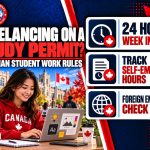
| Program remains in progress and student meets work conditions | Student work rules apply, including the 24-hour off-campus limit during a regular academic term |
| School confirms completion | Ordinary student work generally stops |
| Eligible graduate submits PGWP application while study permit is valid | May work full-time while awaiting the decision if all IRCC conditions are met |
| IRCC approves PGWP | Work under the issued permit and its conditions |
| IRCC rejects or refuses the application | Stop working when notified; assess status and next steps promptly |
In Sofia’s example, the period from receiving the completion email on June 10 until submitting a qualifying PGWP application on June 25 is a potential no-work gap. She should arrange her shifts accordingly. She should verify her complete eligibility before starting full-time work after submission.
Does the 24-Hour Weekly Limit Continue While Waiting?
For a graduate who meets IRCC’s PGWP waiting-period conditions, IRCC permits full-time work until it decides the application. The ordinary 24-hour weekly off-campus limit during a regular academic term is not the limit for that qualifying post-application period.
That does not mean every graduate can immediately move to full-time work on the day of the final exam. First identify the completion notification, submit the application with a valid study permit, and confirm the prior work-eligibility conditions. A student still actively studying before completion remains subject to the rules applicable during studies.
Other restrictions can matter. For example, work in certain health, child-care or other public-health settings may require an immigration medical examination and appropriate permit conditions. The authorization to work while waiting does not eliminate occupation-specific requirements.
Do You Need the Physical Diploma Before Applying?
Generally, no. IRCC says a graduate can use an official completion letter or an official transcript, including a copy from the school’s website, to establish completion for a PGWP application. See IRCC’s explanation about applying before receiving a diploma and its PGWP document list.
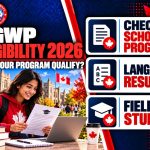
Waiting for a ceremony or printed credential can needlessly consume time while the study permit approaches expiry. However, the application should be complete and include any language results, field-of-study proof or other documents required for that graduate’s program under the current PGWP rules. A document appearing as “optional” in an online checklist may still be required by IRCC for a particular applicant.
Keep the school’s completion notice, final transcript and the date each became available. Use the official IRCC instructions rather than relying solely on a school’s informal estimate of when the diploma will be mailed.
The 180-Day Application Window Is Different From Interim Work Permission
IRCC generally requires a PGWP application within 180 days of confirmation that the program was completed, and the study permit must have been valid at some point during that 180-day period, subject to the other PGWP eligibility criteria.
The 180-day window to apply does not mean a graduate may work throughout all 180 days. To work while waiting for a PGWP decision under IRCC’s stated rule, the study permit must still be valid when the application is submitted, along with the other conditions.
A graduate who applies later while outside Canada, or who applies after the study permit has expired, should not infer that the same interim work authorization applies. Location, status and timing must be evaluated separately.
What If the Study Permit Expires Before the PGWP Application?
IRCC’s PGWP application instructions say that if a person remains in Canada after the study permit expires without first changing to visitor status, they may, within the applicable 90-day restoration period, apply for a PGWP and restore student status. IRCC states that such an applicant cannot work until the work permit is approved. If the restoration period has passed, they must leave Canada.
Restoration is not the same as having maintained valid status through an application filed before expiry. It does not retroactively authorize work undertaken during the gap. A person approaching expiry should review the available options before the permit ends.
IRCC also says an eligible graduate can apply for a PGWP from outside Canada. The ability to submit an application abroad does not by itself authorize work in Canada while it is pending.
What Is the WP-EXT for PGWP Letter?
Some online PGWP applicants receive a WP-EXT for PGWP (IMM 0127 E) letter. It can help demonstrate authorization to an employer while the application is being processed. The letter is evidence connected to a qualifying application; it does not create work permission for someone who fails IRCC’s underlying conditions.
IRCC says an eligible graduate may keep working until a decision even if the letter’s stated validity period expires. If further proof is needed, IRCC directs the graduate to request it through the web form.
Do not read the date on that letter as the final decision date. Likewise, do not rely on a screenshot of a general online account page as a substitute for confirming that the PGWP was actually submitted before the study permit expired.
How Can You Show an Employer You May Work?
IRCC’s employer-proof guidance lists documents an eligible graduate can provide, including:
- Proof of completion, such as the official school letter or transcript
- A copy of the study permit showing the relevant work condition
- The acknowledgement of receipt for the online PGWP application, received before the study permit expired
- A copy of the WP-EXT for PGWP letter, if issued
Keep complete copies of the application, submission confirmation, fee receipt, school records and any IRCC correspondence. The employer may need to understand the dates as well as see the documents. A promise that “my PGWP is in process” without proof may leave important questions unanswered.
If the student’s record does not fit the listed conditions, they should obtain individualized advice rather than ask an employer to accept an unsupported work claim.
Can You Travel While Waiting for the PGWP?
IRCC says leaving and re-entering Canada after applying for a PGWP does not by itself end an otherwise qualifying graduate’s full-time work authorization while awaiting a decision. But travel and admission are separate questions. A traveller needs the appropriate passport and valid visitor visa or electronic travel authorization (eTA), as applicable, and must meet entry requirements at the border.
An in-Canada PGWP application does not necessarily result in a new visitor visa being issued automatically. Check IRCC’s travel instructions after applying before booking a trip.
If a decision is made while the graduate is travelling, reassess the basis for working and re-entry before returning. Do not rely on an old pending-application letter after a refusal.
What If the PGWP Is Refused or Rejected?
IRCC says the graduate must stop working when notified that the work permit application has been refused. Its employer-proof page also addresses rejected applications. Continuing to work after that notice can affect future applications and status.
Save the decision and determine whether the issue involves missing documents, program eligibility, permit status, language or field-of-study requirements, or another matter. The next lawful step will depend on the actual decision and current status. Submitting a new application does not automatically restore the interim work permission from the first one.
Do not change or backdate employment records to hide shifts worked after the decision. Seek advice promptly if there has been any unauthorized work or if status is about to expire.
What If the Program Is Not PGWP-Eligible?
A DLI’s ability to enrol international students does not mean that every one of its programs qualifies for a PGWP. IRCC has separate PGWP eligibility requirements relating to the institution, program length, full-time study, language ability and, for some graduates, eligible fields of study. Other exclusions and special cases can apply.
The work-while-waiting question should therefore be considered alongside whether a valid PGWP application can be made. If the graduate is not eligible for a PGWP, another type of work permit may be possible in some cases, but it has its own rules. The prior study permit alone does not authorize continuing work after completion.
A Practical Checklist Before Taking a Post-Completion Shift
- Obtain and save the first official school notice confirming completion.
- Identify the date ordinary student work must stop.
- Confirm the study permit is valid when submitting the PGWP application.
- Verify prior off-campus work eligibility and compliance with hour limits.
- Check PGWP program, language, field-of-study and document requirements.
- Submit the application within the applicable window and keep proof of submission.
- Confirm that all waiting-period work conditions are met before starting full-time work.
- Provide the relevant IRCC-listed documents to the employer.
- Monitor the IRCC account and stop work immediately if a refusal or rejection ends authorization.
A 101 Legal Ways Educational Example
After reading 101 Legal Ways guides, Sofia reviewed the email from her college and recognized June 10 as the date she had been notified of completion. She told her supervisor that she could not assume her old student-work authorization covered the shifts scheduled before she submitted a PGWP application.
She collected her completion letter and transcript, checked her prior off-campus eligibility and work records, and reviewed the program-specific PGWP documents. She submitted while her study permit was still valid and saved the acknowledgement and any later IRCC letter. Only after confirming that she met the waiting-period conditions did she accept full-time shifts.
Sofia is fictional and is not a real client. The example does not guarantee a PGWP or work authorization for another graduate. It shows how a clear timeline can prevent an avoidable period of unauthorized work.
101 Legal Ways provides public education about Canadian legal and immigration procedures. Its guides help readers understand official rules, organize records and ask better questions before important decisions.
Four Actionable Takeaways
- Stop at official completion. A completion letter, transcript or school email generally ends ordinary student work authorization; a later graduation ceremony does not extend it.
- Check every waiting-period condition. Full-time work while a PGWP is pending requires a qualifying application submitted with a valid study permit and prior off-campus work eligibility and compliance.
- Separate the deadlines. The 180-day PGWP application window does not mean 180 days of automatic work authorization.
- Keep proof and monitor the decision. Save school and IRCC documents, show an employer the required evidence, and stop working if the application is refused or rejected.
Final Thoughts
The transition from studying to working is a sequence of legal events, not a single graduation date. Student work generally stops at official completion. Some graduates can work full-time after submitting a qualifying PGWP application while IRCC processes it. The dates of completion, study permit validity and application submission determine whether there is a gap.
Read the school’s notice, the permit and the current IRCC instructions together before accepting a shift. Where prior work eligibility, status or application completeness is in doubt, obtain advice tied to the actual record.
Official Government Sources
- IRCC: Can I continue to work after finishing my study program?
- IRCC: PGWP — After you apply
- IRCC: Can I work while waiting for my PGWP?
- IRCC: How to show an employer you may work while waiting
- IRCC: PGWP — How to apply
- IRCC: PGWP — Who can apply
- Department of Justice Canada: Immigration and Refugee Protection Regulations, section 222
Legal Disclaimer
This article provides general public legal and immigration information only. It is not legal advice and does not create a lawyer-client or consultant-client relationship. Immigration rules, institutional procedures and individual circumstances may change. Consult current IRCC guidance, your DLI or an authorized Canadian immigration professional for advice about your specific status and work authorization. Information was reviewed against official guidance available on September 29, 2026.