




































A Canadian college student may have a mandatory internship on the program calendar and still be unsure whether a separate co-op work permit is needed. An older school checklist might say yes. A prospective employer might ask for a permit number. The student might also assume that the ordinary off-campus work limit applies to every hour of the placement.
The rules changed on April 1, 2026. Eligible international students in post-secondary programs no longer need a separate co-op work permit for a required student work placement. The change does not turn every internship or job into an authorized placement. The student must meet IRCC’s conditions, and secondary-school students still need a co-op work permit.
Consider Amira, a fictional student in a Canadian college program with a required full-time internship. Her study permit includes a work condition, and the college has approved an employer. She has a letter confirming the placement is mandatory. Her friend, whose unrelated summer job is optional, cannot use Amira’s placement rules to justify the same schedule.
This guide explains who qualifies, which documents to check, how placement hours differ from ordinary employment and what to do if an application is already pending. It is general public information, not a guarantee that a particular student may work.
What Changed on April 1, 2026?
IRCC announced that eligible post-secondary international students no longer require a separate work permit for a student work placement required by their program, such as a co-op or internship. They may work for an employer accepted by their designated learning institution (DLI) as part of the program requirements.
This removes an administrative step for eligible students. It does not give all study permit holders a general open work permit. The school-approved placement must remain part of the qualifying program, and the student must satisfy the eligibility conditions on IRCC’s student work placement page.
Students who already hold a co-op work permit may continue using it until its expiry. Secondary-school students still need a co-op work permit for a qualifying placement.
| Student and activity | Separate co-op work permit in 2026? |
|---|---|
| Eligible post-secondary student in a required, school-approved placement | No |
| Secondary-school student in a qualifying placement | Yes |
| Post-secondary student taking an unrelated optional job | The placement exemption does not cover it; check ordinary student work authorization or another work permit |
| Student in a non-qualifying course or program | Cannot rely on the student placement authorization |
The label an employer uses is not decisive. A position called an “internship” must still satisfy IRCC’s program and student conditions.
What Counts as a Student Work Placement?
IRCC describes student work placements as work experiences required for a study program and approved by the DLI. They may include co-op terms, internships, practicums and mentorship programs. The program must be at a Canadian DLI; the student placement rules do not apply to a student studying at a school outside Canada.
The key question is whether completing the work is required to obtain the credential. A job that is merely useful for a résumé does not become a student work placement because the school advertises it or grants access to a job board.
Ask the school to confirm the requirement in writing. The letter should identify the student and program, say the placement is required to complete the credential, and describe the placement’s role in the curriculum. IRCC may also ask for confirmation that all students in the program must complete work placements to receive their degree, diploma or certificate.
The DLI must accept the employer within its student work placement program. An employer selected independently is not automatically approved merely because the student studies at that institution.
The Post-Secondary Eligibility Checklist
IRCC says a post-secondary student may participate in a student work placement when all of these conditions are met:
- The placement is required to complete the study program.
- The initial study permit has printed conditions saying the student may work on campus.
- The student has a DLI letter confirming the placement is a program requirement.
- The student has a valid study permit, or applied to extend it before it expired.
- The student is studying full-time at a DLI in a post-secondary academic, vocational or professional training program.
- The program’s work placement totals 50% or less of the study program.
Read the current IRCC criteria against the student’s actual permit, school letter and program structure. Do not rely on an old co-op application checklist or another student’s permit.
The reference to the initial study permit’s work condition matters. A student who believes they qualify but lacks an appropriate printed condition should follow IRCC’s process to have the condition added before working. IRCC says there is no fee to add the specified conditions. A verbal assurance from an employer does not amend a permit.
Which Study Permit Conditions Should You Check?
IRCC lists two possible printed conditions for an eligible student who needs them added. One allows employment on or off campus if the person meets the relevant criteria under paragraphs 186(f), (v) or (w) of the Immigration and Refugee Protection Regulations. The other restricts off-campus work but permits on-campus work if the person meets paragraph 186(f).
The second condition may look surprising when a placement employer is off campus. IRCC nonetheless lists it among the conditions for the student placement process and separately says an accepted placement employer can be off campus. Follow the specific IRCC placement instructions for the student’s case rather than inferring eligibility from a single phrase in isolation.
If neither listed condition appears on the permit, IRCC says the student cannot work until a qualifying condition is added. The student can request an amendment and should ensure all the other placement requirements are met. The same printed condition is relevant when applying for a social insurance number (SIN).
Keep copies of the study permit, DLI letter and school placement approval. An employer may need a clear explanation of why a post-secondary student does not have a separate co-op work permit after the 2026 change.
Can a Co-op Placement Be Full-Time?
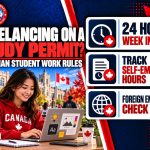
Yes, a qualifying student work placement has no weekly hour limit under IRCC’s placement rules. The placement cannot exceed 50% of the overall study program. These are different limits: one concerns hours in a given week, while the other concerns the proportion of the program made up of work placements.
For example, a full-time term may be compatible with the placement rule if the program’s total placement component stays within the 50% ceiling and all other conditions are met. The student and school should verify the program’s total structure instead of assuming that a full-time week is prohibited.
Do not apply this no-weekly-cap statement to a separate part-time job. Ordinary off-campus work rules have their own eligibility conditions and limits during regular academic sessions. A student with both a required placement and an unrelated job should assess each activity under its applicable rule and maintain clear records of hours and duties.
The school-approved placement authorization does not become a general permission to work for any employer or to continue the same job after the placement ends. If employment continues outside the required placement, the student needs a separate basis for that work.
Where Can You Work?
IRCC says a student may work for any employer accepted by the school’s student work placement program, even if that employer is off campus. School acceptance is the practical dividing line. A student should confirm that the specific placement, employer and term are approved.
Some placements bring an additional medical requirement. IRCC says a student needs a medical exam for a placement at a hospital or another workplace where protection of public health is important, unless the student has already had one. A healthcare or similar placement should be checked early, before an employer sets a start date. A separate work permit exemption does not remove medical admissibility conditions.
Depending on the type of work, the student may also need a SIN. IRCC explains that the necessary condition must be printed on the study permit to apply for a SIN and links to Service Canada’s application process.
When Must a Student Stop a Placement?
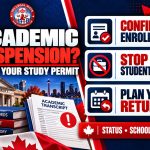
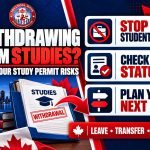
IRCC says a student must stop participating in a student work placement:
- On the day they stop studying full-time, subject to the final-semester exception identified by IRCC
- When their study permit expires
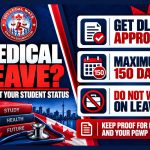
- During an authorized leave from studies
- While switching schools if they are not currently studying
IRCC also lists a timely study permit extension application as one route within the eligibility criteria. Students relying on an extension filed before expiry should check the status and work conditions carefully. The timing of the application and continued compliance matter; a late application is not the same situation.
A student can return to a placement after resuming studies if they again meet all the student work placement requirements. The school should confirm whether the placement remains required and approved after a change in schedule or program.
Do Secondary-School Students Still Need a Co-op Work Permit?
Yes. The April 2026 removal of the separate co-op permit requirement is for eligible post-secondary students. International students at the secondary level still need a co-op work permit to complete student work placements in Canada.
IRCC lists these conditions for a secondary student’s co-op permit: a valid study permit; a required work component in a Canadian study program; a school letter confirming that all students must complete placements for the secondary diploma or certificate; and a placement or internship totaling no more than 50% of the program. A SIN may be needed depending on the work.
IRCC states that there is no fee for a secondary-school co-op work permit. Its application instructions distinguish students applying with their study permit from those already in Canada. If the student is applying from outside Canada, pay attention to IRCC’s instruction about applying for the co-op permit together with the study permit.
Do not tell a secondary-school student to begin an in-Canada placement based solely on the post-secondary 2026 announcement.
What If You Already Have or Applied for a Co-op Work Permit?
An existing co-op work permit may be used for its remaining validity. There is no automatic need to replace it simply because IRCC changed the post-secondary process.
If a post-secondary student already applied for a co-op work permit but meets the new requirements and no longer needs one, IRCC says the student may withdraw the application. IRCC may also withdraw the application and send a letter explaining the change. Its April 2026 notice says students with eligible active applications awaiting a decision do not need to take action because IRCC will withdraw them.
Before deciding whether to withdraw anything, verify that the placement and student truly meet the new conditions. A pending application does not itself fix a missing study permit work condition or convert an optional job into a required placement. Keep any IRCC correspondence with the student’s immigration records.
Who Cannot Use the Student Placement Rules?
IRCC says a student cannot participate under these placement rules when taking only:
- English or French as a second-language courses
- General-interest courses
- Courses intended to prepare for another study program
- Courses at an institution outside Canada
The student also cannot use the placement authorization for a voluntary job that is not required to complete their program. If they want to work in Canada and do not qualify for the student placement authorization, they must determine whether a different work authorization applies. IRCC directs otherwise ineligible students who want to work to apply for a work permit.
An unpaid position is not automatically outside immigration work rules. The decisive practical step is to assess the activity and applicable authorization, not assume that a lack of wages removes the need to check.
Documents to Prepare Before the First Day
A student and school can organize a short evidence package:
| Document | What it helps establish |
|---|---|
| Valid study permit or proof of a timely extension application | Current immigration status and permit conditions |
| DLI letter confirming the placement requirement | The work is required to complete the program |
| Official program outline | The curriculum and overall placement proportion |
| School placement approval | The particular employer and role are accepted |
| Placement agreement and dates | The scope and duration of the work |
| Medical exam evidence, if relevant | Eligibility for public-health-sensitive work |
| SIN, if required for the work | Payroll and employment administration |
The school letter should be specific enough to answer an employer’s question. If the program includes multiple placements, confirm the total share of the program and keep records for each. A change of employer should be approved through the DLI’s placement process.
If a permit lacks a required condition, address that before the start date. If the student has taken leave, stopped full-time studies or changed schools, reassess eligibility instead of using an earlier approval indefinitely.
Common Mistakes to Avoid
Assuming Every Internship Qualifies
The work must be required to complete the program and approved by the DLI. An optional résumé-building opportunity is different.
Treating the Change as a General Open Work Permit
The student placement rule applies to an accepted curricular placement. Other employment has separate conditions.
Ignoring the Printed Study Permit Condition
IRCC expressly requires a qualifying work condition on the initial permit and gives an amendment route when the listed wording is missing. Do not begin work based solely on a school letter.
Applying the Weekly Off-Campus Cap to the Placement
IRCC says there is no weekly hour cap for a qualifying placement, while the total placement component cannot exceed half the program. Ordinary jobs remain subject to their own rules.
Overlooking a Medical Exam
Hospital and other public-health-sensitive placements may require an immigration medical exam.
Applying the Post-Secondary Rule to High School
Secondary students still need the co-op work permit.
Continuing After Eligibility Changes
Permit expiry, authorized leave or a loss of qualifying full-time enrollment can require the student to stop participating.
A 101 Legal Ways Educational Example
Amira reviewed her college’s curriculum and found that the internship was mandatory for every student to obtain the diploma. The placement office approved the employer and issued a letter confirming the requirement. Her initial study permit contained an eligible printed work condition, she remained a full-time student, and the program’s total placements were less than half of the program.
Her prospective employer initially requested a co-op work permit. Amira provided the college’s confirmation and IRCC’s current placement instructions showing that eligible post-secondary students no longer need a separate co-op permit. She also checked whether the role required a medical exam and obtained a SIN where needed.
Her friend had a voluntary job unrelated to a required placement. That friend checked the separate off-campus work rules rather than using Amira’s authorization. Neither person assumed that the title “intern” settled the immigration question.
Amira is fictional and is not a client. Her example shows how to verify a required placement and distinguish it from ordinary work. It does not guarantee authorization for another student’s circumstances.
101 Legal Ways provides practical public education about Canadian laws and immigration procedures. Its guides help students read official instructions, organize evidence and ask better questions before taking important steps.
Four Actionable Takeaways
- Confirm the placement is mandatory. Get a DLI letter and the school’s approval of the employer.
- Check the student and permit conditions. Full-time enrollment, a valid permit or timely extension, and the required printed work condition matter.
- Separate placement hours from ordinary work. A qualifying placement has no weekly cap but cannot exceed 50% of the study program; unrelated jobs follow different rules.
- Apply the correct school-level rule. Eligible post-secondary students no longer need a separate co-op permit, while secondary students still do.
Final Thoughts
The 2026 change makes required placements simpler for eligible post-secondary students, but the eligibility test remains specific. A school-approved curricular placement, the DLI’s letter, full-time studies, permit wording and the 50% program ceiling all matter.
Before beginning work, compare the student’s documents with the current IRCC instructions. If the placement or immigration status changes, check the conditions again. The absence of a separate co-op permit requirement should never be mistaken for unrestricted employment authorization.
Official Government Sources
- IRCC: Work in a student work placement
- IRCC: April 9, 2026 notice on simplifying the co-op work permit requirement
- IRCC: Work off campus as an international student
- IRCC: Working in Canada as an international student
Legal Disclaimer
This article provides general public legal and immigration information only. It is not legal advice and does not create a lawyer-client or consultant-client relationship. Immigration rules and individual circumstances may change. Consult current IRCC instructions, the designated learning institution or an authorized Canadian immigration professional for case-specific advice. Information was reviewed against official guidance available on October 8, 2026.